 One time Donation
 Events
 Recurring Gift
 Employer Gift Matching
 Stocks & DAF
 Endowment
 Justice Circle
 (Raleigh, NC – January 30, 2026) North Carolina is the only state that entered the new year without a budget. More than 200 days have passed since lawmakers failed to meet the July 1, 2025, deadline to approve one for the 2025–2027 fiscal year.
The budget determines key funding for education, health care, and infrastructure, but lawmakers likely won’t be voting on any measures until April. As a result, teacher salaries are frozen, and school districts are unsure whether they will get necessary funding for classroom materials, instructional support, professional development, and adequate staffing.
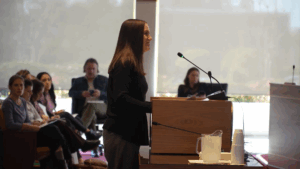
“We’re not respected and valued as we should be. The critical role that we play for students and our community’s well-being is not valued. Teachers do more with fewer resources. Without proper compensation, your morale just erodes,” said Mary Jane Bowman, 2025 Person County Teacher of the Year.
In November of last year, Bowman gathered with other educators and community advocates to express how this financial uncertainty has hampered student development, devastated learning environments, and negatively impacted the lives of teachers during a public hearing titled the “The Real-World Impact of Failing to Pass a State Budget” at the NC General Assembly. Organized by the North Carolina Senate Democratic Caucus, the hearing sought to convey the growing consequences of the budget impasse. Several NCJC staff members attended the hearing.
“Generations of North Carolina’s children have had their constitutional right to educational opportunities violated for the past 40 years. The landmark Leandro case, originally filed with state courts from all ideological backgrounds, consistently finds that this violation is ongoing,” said Matt Ellinwood, Director of the Education & Law Project.
“The state has never developed a plan to remedy this violation, but one has been developed in the Leandro case, which the Legislature refuses to fund and implement. Now, the lack of a state budget leaves us even further today from funding and implementing a sound, basic education for all students than we were 40 years ago,” Ellinwood continued.
Educators have long shouldered the burden of reaching into their own pockets to provide basic supplies for their students. While the funds needed to supply classrooms continue to increase, teacher pay has stagnated. A recent report by the North Carolina Association of Educators reveals that teachers across the state are now spending more than $1,600 of their personal money on supplies.
“More than half of the professionals working with children every single day are working under the same pay they had before, despite growing responsibilities and ever-increasing expectations,” Bowman said.
“This year, health care costs have increased dramatically for educators and staff across our district,” she continued. Bowman said this has forced many educators, including herself, to find cheaper health plans.
“For teachers with six or more years of experience, premiums have doubled. And in many cases, they are paying more for less coverage. These are educators who have committed years of their lives to serving students. Yet they are being asked to shoulder an unfair financial burden just to maintain essential healthcare,” Bowman said.
She reported she had to drop from the 80/20 plan to the 70/30 plan after costs doubled.
Bus drivers, instructional assistants, cafeteria workers, custodians, and office staff have also experienced loss of wages“For these employees, take-home pay has decreased anywhere from $120 to $312 a year. These are also individuals who did not receive a raise and already work for modest wages and losing this amount has an impact on their ability to meet basic needs,” she explained.
Bowman said underpaying teachers and support staff sends a painful message—that public education is not a priority for the state.
As a result of being undervalued and unsupported, it makes it harder for schools to recruit and retain qualified teachers, which hurts student outcomes, school culture, and the overall quality of education.
“The high turnover rate and a lack of stability affect classrooms,” Bowman said. “It’s uncertainty for the students. It’s uncertainty about, ‘who am I going to see in my building?’ Consistency is required for building relationships with [the children we serve],” she explained.
“Our teachers deserve stability. They deserve competitive pay. And they deserve a budget that reflects the importance of the work they do every single day,” Bowman said.
This story highlights just some of the challenges school districts across the state are facing. The NC Justice Center calls for the North Carolina General Assembly to pass a budget that prioritizes health care and provides full funding for public education as mandated under the Leandro Plan.
Read our previous article to learn how the lack of a state budget is impacting healthcare.