 One time Donation
 Events
 Recurring Gift
 Employer Gift Matching
 Stocks & DAF
 Endowment
 Justice Circle
 (Durham, NC – January 26, 2026) Tenants in Durham now have new protections, thanks to the lobbying work of 17-year-old Milo Graber and Riverside High School’s Affordable Housing Club. Durham City Council unanimously approved an amendment to the city’s housing code in October 2025. The new ordinance, modeled after a similar law in Charlotte, makes it illegal for landlords to collect rent from apartments or homes with unsafe or dangerous living conditions.
This includes having unsafe wiring, unsafe ceiling or roofing, unsafe drinking water, severe pest infestations, heating equipment that doesn’t work in the winter months, and non-functioning toilets. If landlords do not fix these issues within 72 hours, they can be found in violation of the new ordinance.
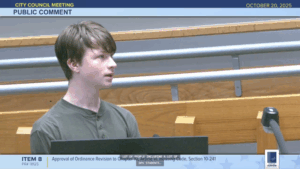
Graber and supporters of the ordinance say it’s a powerful tool that tenants can use to enforce the basic standards of habitability in their homes, and even the playing field if eviction proceedings are initiated. “They can bring this to the negotiation table,” Graber said, and use it to defend themselves against landlords demanding rent for unsafe or unstable units.
“It will make landlords more likely to maintain their properties in safe and livable condition because of the risk of losing rent payments if they don’t,” Graber wrote in his Op-Ed for INDY Weekly.
Safe, affordable housing has long-dominated conversations amongst Durham’s leaders and community members. “Everyone agrees we have an affordable housing crisis. But it’s difficult for us to do anything because we’re arguing about how we should address this,” he said. During his sophomore year, Graber conducted a research project on housing policy in relation to slumlords. He interviewed Peter Gilbert, Litigation Director for the NC Justice Center, who talked with him about a housing ordinance Charlotte passed in 2007 that protected tenant rights.
“Due to the high demand for affordable housing and limited supply of subsidized units, tenants are often left with no choice but to accept substandard housing and landlords have little incentive to make necessary repairs. This ordinance should improve the bargaining position of tenants seeking safe and affordable housing,” Gilbert said.
This inspired Milo to get a similar law passed in his community.
“I felt like [the ordinance] was a commonsense thing that should be on record. Landlords are focusing more on how much money they can bring in rather than giving people a safe place to live,” Graber said.
Graber has lived in Durham for most of his life and has seen how unstable housing conditions interfere with the lives of his peers and classmates. “Struggling to pay rent makes it very hard for people to stay in one home for a long period of time,” he said.
“A lot of DPS students live in unsafe and unhealthy conditions and live in fear of being evicted because they are being charged such high levels of rent for these units. [In some cases,] students face being evicted. That can be very disruptive, especially if they’re forced to move school districts because they had to find housing in a different area,” Graber said.
“If you’re joining as a sophomore, junior, or even a senior, it’s so much harder to get to know people because they already have an established friend group and may not be willing to branch out,” Graber explained. He also witnessed how this affects a student’s ability to focus on school and complete assignments.
After finding other students who wanted to advocate for those affected by unsafe and unreliable housing, Graber co-founded Riverside High School’s Affordable Housing Club. Soon after, the group began to mobilize. The students attended eviction court proceedings and started interviewing attorneys. In January 2025, the group wrote a report on the ordinance in Charlotte, detailing its impacts and its authorization under North Carolina law, and explained why it should be implemented in Durham.
They sent the report to community organizations in the spring, including the Triangle Tenant Union and Durham’s People Alliance, the latter of which connected them to councilwoman Chelsea Cook, who represents Durham’s west end neighborhoods.
“When we met with her, she thought it was a really great idea, and wanted to support it,” Graber said. Once they crafted a proposal, Councilwoman Cook added it to the agenda for the next work session.
All seven city council members voted to adopt the measure. “I was surprised that it passed unanimously because it felt like the councilmembers were on the fence about it during the work session,” Graber said.
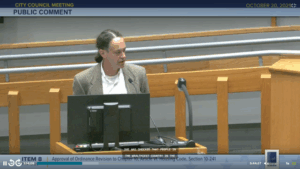
Gilbert spoke in favor of the ordinance at the October City Council meeting. “The sustained advocacy of the students, community groups, and organized tenants, including the NC Tenants Union, was pivotal in passing the ordinance,” Gilbert said. Former NC Justice Center attorney Jack Holtzman also spoke in favor of it at a prior meeting.
Durham is the now the fourth municipality in North Carolina to adopt an ordinance banning landlords from collecting rent if units are deemed unsafe. “My favorite part of this process was meeting with community organizations and talking to people who wanted to help, and asked, ‘what can we do?’, “he said.
Graber is graduating from Riverside High School later this year and plans to attend college in the fall. He hopes the Affordable Housing Club that he and his peers started will continue its work to defend and support Durham residents.