 One time Donation
 Events
 Recurring Gift
 Employer Gift Matching
 Stocks & DAF
 Endowment
 Justice Circle
 Scammers may impersonate immigration attorneys, judges, ICE officers, or USCIS agents. Some even use AI, fake documents, or video calls to realistically impersonate attorneys or government officials. This guide explains how to protect yourself.
Download the guide in English
Download the guide in Spanish
Red flags of immigration scams: Exercise caution when choosing a representative or when interacting with the government.
When looking for representation
- Someone contacts you directly to offer their services on platforms like Facebook, WhatsApp, Instagram, or TikTok
- They request payment without a written contract (retainer agreement).
- They request payment over the phone, by text, or through email in the form of gift cards, wire transfers, or cryptocurrency, or electronic payment services such as Zelle or CashApp.
- They ask you to make a payment for an Immigration Court filing fee by check or in cash to EOIR. EOIR only accepts online payments through their official portal at epay.eoir.justice.gov/index.
- You should always verify the filing fees due in your Immigration Court case at justice.gov/eoir/types-appeals-motions-and-required-fees
- They fail to provide you with a written retainer agreement documenting your agreement, if they represent you.
- They ask you to sign blank immigration applications or other forms (a real lawyer will always review your answers with you before signing).
- They absolutely guarantee a certain result in your case (a real lawyer will never make a guarantee of success).
- They present themselves as a “notario público” rather than lawyer, or use the phrase “immigration services” with no reference to the word lawyer or law firm.
- They claim they have ‘connections’ in the government, with ICE, or with Judges.
When going to Immigration Court
- They say you must pay them immediately to avoid arrest or deportation.
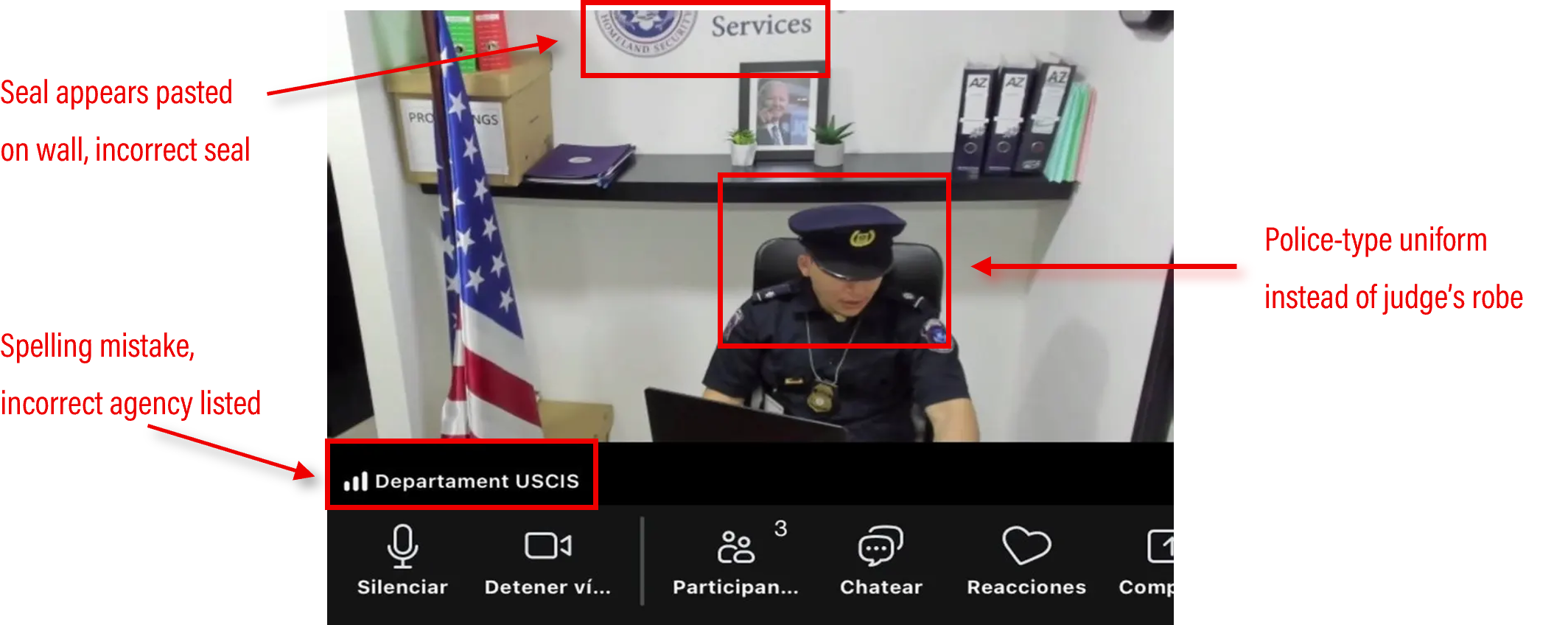
- They send documents with spelling errors or incorrect government seals.
- Example: EOIR (immigration court) seal (left) and DHS (ICE, USCIS) logo (right)


- They tell you that you have a court hearing on Zoom, Google Meet, or another unofficial platform.
- They contact you personally by phone, text, email, or social media. Judges will only send you official notices by mail. However, if your case is registered online on ECAS (EOIR Courts & Appeals System), you would receive notice of all documents filed by the Court and ICE electronically through the official portal at justice.gov/eoir/respondentaccess
Protect yourself when hiring an immigration service provider.
You have the right to a lawyer, but the government is not required to pay for it (meaning you must hire your own attorney or find a nonprofit organization that will represent you for free). Unfortunately, there are a lot of scammers that try to capitalize off immigrants seeking representation in scary times. It’s critical that you stay informed and protect yourself from being defrauded.
(The Immigration Court administers a program that allows non-attorney employees and volunteers of qualifying nonprofit organizations to practice immigration law before the federal government. Currently, more than 2,000 BIA-accredited representatives working for nonprofits across the United States are authorized to represent immigrants at low or no cost.)
If looking for a qualified representative:
- Ensure that the nonprofit organization is legitimate and that the person you are working with is accredited by the Department of Justice by checking: justice.gov/eoir/media/1398081/dl?inline
If looking for a qualified immigration lawyer:
- Look for a lawyer on reputable websites like the American Immigration Lawyers — Association (AILA) ailalawyer.com
- Verify whether the individual is a licensed attorney using the North Carolina State Bar Directory: portal.ncbar.gov/Verification/search.aspx (if applicable).
- Keep in mind that immigration attorneys are allowed to practice immigration law in states where they are not licensed, as this area of law is federally regulated (meaning it does not rely on state law).
- Check this list to see whether the lawyer has been disciplined for violating rules: justice.gov/eoir/list-of-currently-disciplined-practitioners
Some scammers steal real lawyers’ names. Always confirm you are speaking to a real attorney by:
- Looking up the attorney online through trusted websites (ncbar.gov and ailalawyer.com)
- Calling the supposed lawyer’s office directly using a verified number that you did not get directly from your first contact (look up their office number online).
- Confirming office address of their physical office; check maps online to see if that is a real address.
- Meeting in person, if possible.
If you are told you have a court hearing.
If you are in Removal (sometimes known as Deportation) Proceedings, it’s important to know how Immigration Court Works. Only a real Immigration Judge can decide on Removal Court cases.
Immigration Judges:
- wear black robes, not police or ICE uniforms
- will place you under oath before you give testimony
- will not ever ask for money
- will only speak English in court, even if they know other languages.
- If you require an interpreter, you have the right to request one at no cost to you in your preferred language. Everything the Immigration Judge says will be interpreted in that language by a qualified interpreter.
In-Person and Virtual Hearings
Some immigration hearings are held virtually rather than in person or telephonically. Some Immigration Judges appear only virtually. For example, the Richmond Immigration Adjudication Center (RIAC) is fully virtual.
Important: All official virtual Immigration Court hearings use WebEx.

- The web address should look like: eoir.webex.com/meet/IJ.LastName
- Each IJ’s WebEx link can be found at justice.gov/eoir/find-immigration-court-and-access-internet-based-hearings
- If your “hearing” is on Zoom, FaceTime, Microsoft Teams, Skype, Google Meet, or another platform — it is NOT an official immigration hearing
If you do not know:
- Whether your hearing is virtual or in-person
- Who your Immigration Judge is
- When or where your hearing is occurring
- You can check online or by phone, but you must have your Alien Number (A#) to confirm your case:
- Online at the EOIR case portal at: acis.eoir.justice.gov/en
- By phone at 1-800-898-7180
- By calling your local immigration court. For example, all North Carolina cases belong in the jurisdiction of the Charlotte Immigration Court which can be reached at 704-817-6140.
An example of what a REAL WebEx Immigration Courtroom could look like:
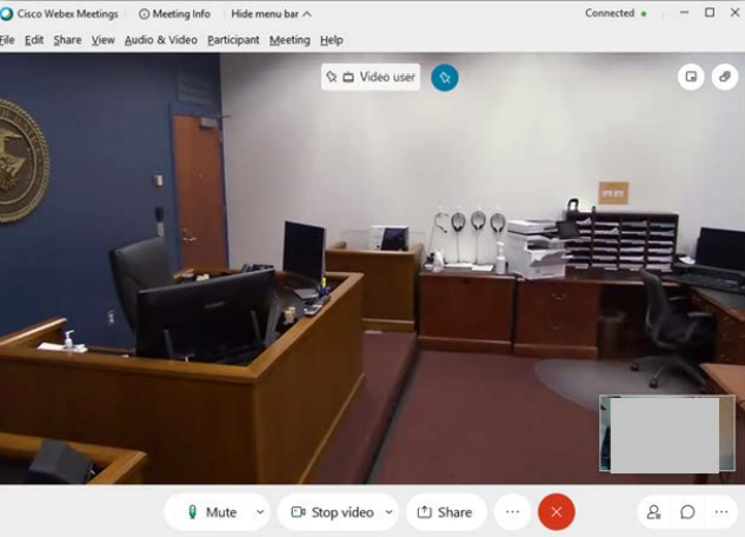
Only Immigration Judges are authorized to hear Removal (Deportation) Proceedings.
A USCIS Officer or ICE Officer in a police-type uniform or plain clothes without a robe is a good sign that the hearing is a scam.
Below is a screenshot example of a FAKE hearing:
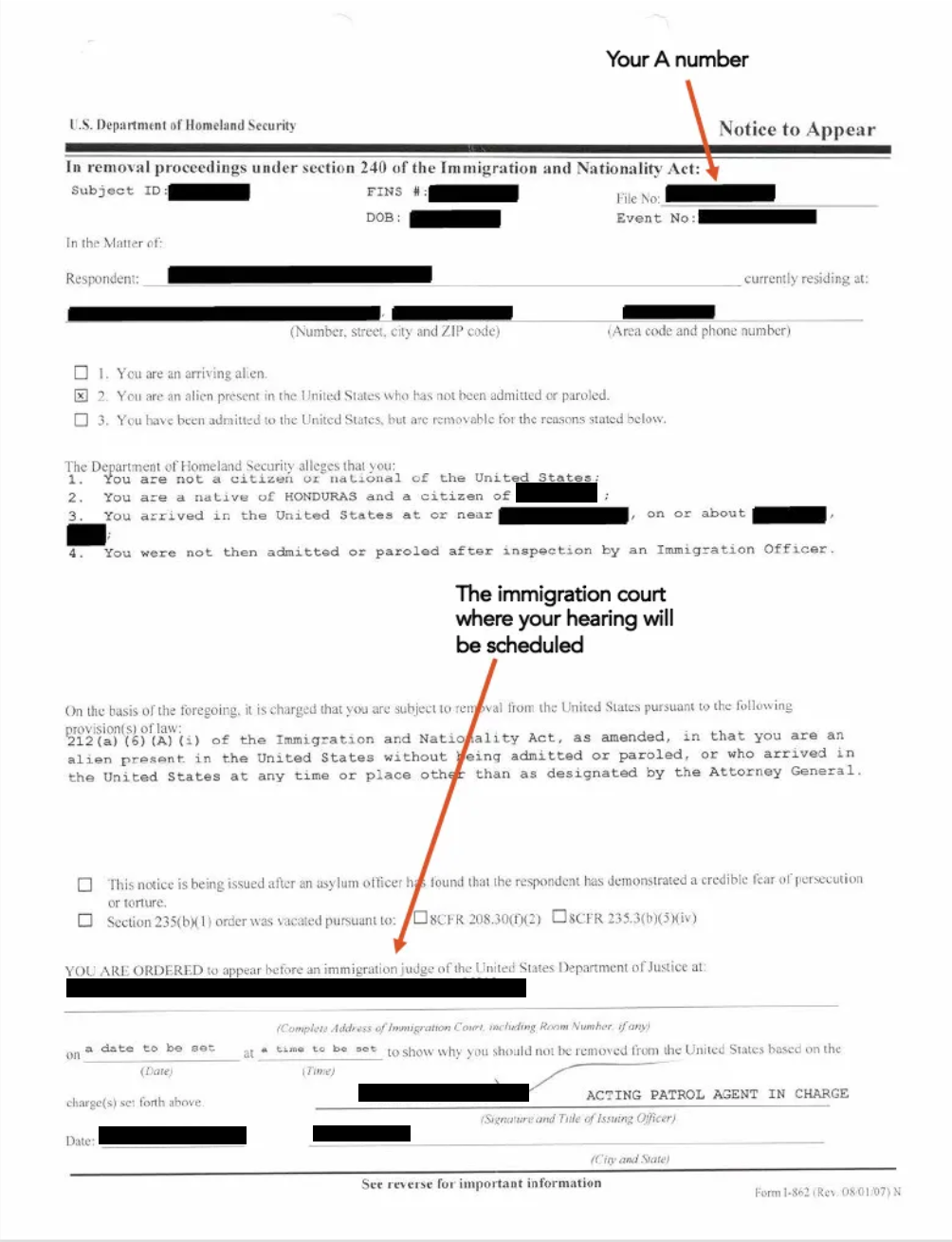
Make sure you receive a Notice to Appear (NTA).
Removal proceedings officially begin when you are served with a Notice to Appear. Scammers sometimes claim you are in deportation proceedings to make you afraid and pressure you into acting quickly.
- ICE must serve you with the Notice to Appear and file it with the court before proceedings can begin.
- It includes your name, address, and A-number.
If you have NOT received an official Notice to Appear, you are not in removal proceedings.
Remember these tips!
- A “notario público” in the U.S. is not an attorney and cannot represent you in Immigration Court before an IJ.
- US Department of Justice Fully Accredited Representatives can represent you in Immigration Court before an Immigration Judge.
- Never sign blank forms.
- Always keep copies of documents for your records.
- Always sign a complete written retainer agreement with your legal service provider that explains their fees and what services they are providing to you.
How to report immigration scams in North Carolina.
If you suspect fraud, report it to the North Carolina Department of Justice (NCDOJ) Consumer Protection Division:
- Online complaint form at ncdoj.gov/complaint
- Call 1-877-5-NO-SCAM
Reporting a scam will not affect your immigration status.
If the complaint involves an attorney licensed in North Carolina, report them to the North Carolina State Bar at ncbar.gov/for-the-public/i-am-having-a-dispute-with-a-lawyer/filing-a-grievance.