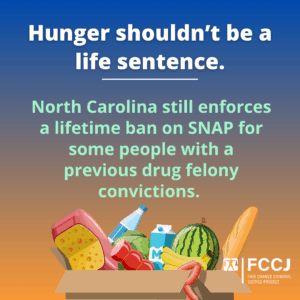
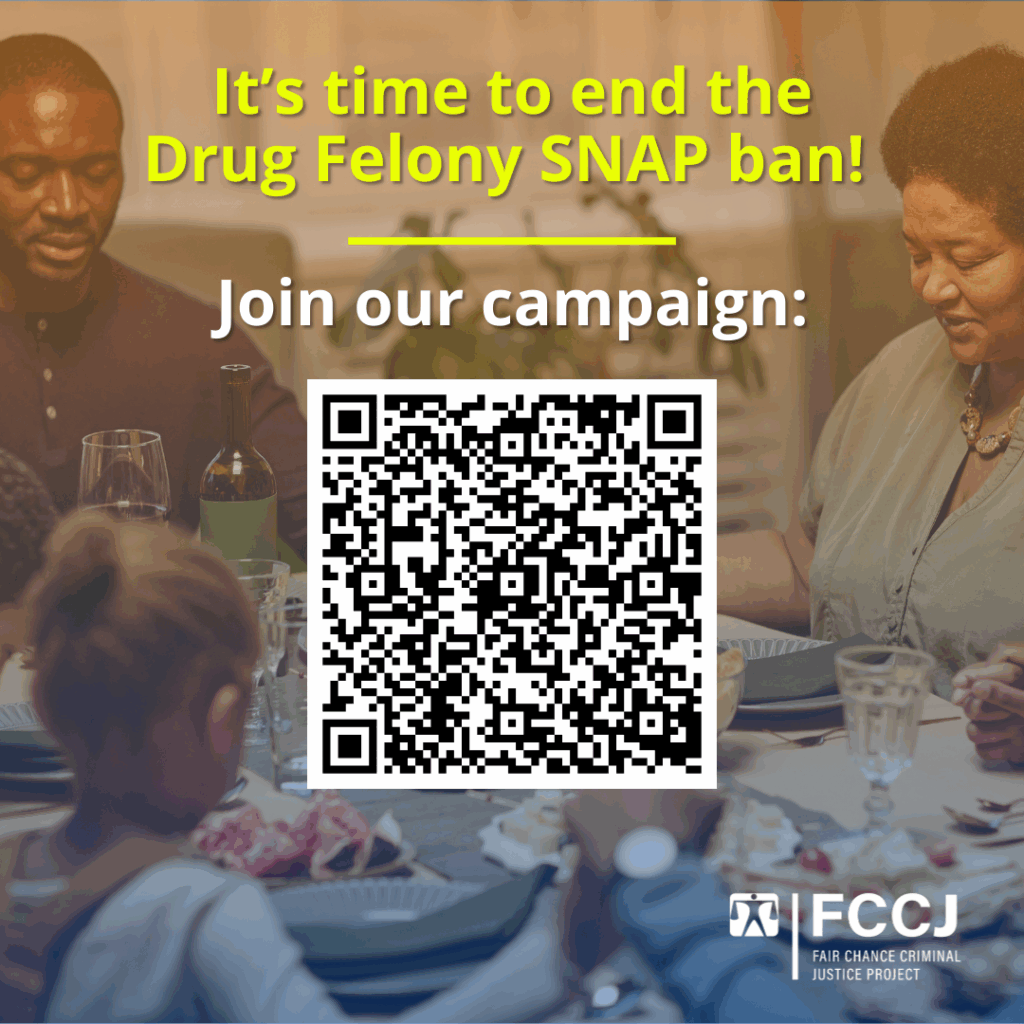
The NC Justice Center remains committed to improving access to food assistance for people living in North Carolina. Our efforts include advocating for North Carolina to change its statewide law to remove the bans to food assistance for people with certain drug-related felony convictions.  

RALEIGH (September 30, 2024) – As Executive Directors and leaders of community-based organizations around the state dedicated to health equity and affordable and accessible health care for all North Carolinians, we are releasing this letter to urge hospital leaders to follow the exemplary leadership and example set forth by Advocate Health in canceling liens for thousands of homeowners and forgiving all outstanding medical debt associated with those liens, in a way that doesn’t create additional tax liabilities for patients.

The home is a vital cornerstone of the American dream, upward economic mobility, and intergenerational wealth for families. It is therefore essential for hospitals to cancel liens and live up to their mission of taking care of patients, restoring their health, and maintaining dignity for all who seek care.

Read the full text of the letter here.

###

Español abajo

Does this affect me?

You might be owed money for unpaid wages from Las Princesas Corporation, Martha Zeferino José, and/or The Tankard Nurseries, Inc. (Defendants).

If you worked for any of the Defendants as an H-2A worker at any time in the three years immediately preceding the date of this notice, this may affect you.

What’s this about?

A lawsuit has been filed against Defendants in the United States District Court for the Eastern District of Virginia. The lawsuit is currently known as Hernández Lara v. Las Princesas Corporation, Civ. Action No. 2:24-cv-00346-JW-RJK.

The workers (“Plaintiffs”) who brought this case say that:

  • They paid recruitment fees, the cost of their H-2A visa and visa-related processing fees, travel within Mexico, lodging near the U.S. Consulate, travel to the job site in the U.S., border crossing fee, and/or inbound food costs, and they were not fully reimbursed for those costs after beginning work.
  • They were not paid properly for all hours worked because of unlawful deductions for meals, which means that they did not get paid the legally required minimum wage for every week they performed work.

If you think either of these things happened to you too, this is your notice to file a claim.

How do I file a claim?

You must fill out the attached Consent to Join FLSA Unpaid Wages Lawsuit and return it by March 6, 2025.

Read more information about the lawsuit. 

¿Esto Me Afecta A Mi?

Podría ser que se le deba dinero por salarios no pagados por Las Princesas Corporation, Martha Zeferino José, y/o The Tankard Nurseries, Inc. (los Demandados).

Si usted trabajó para cualquier de los Demandados como trabajador H-2A en cualquier tiempo en los tres años de inmediato precedente a la fecha de este aviso, puede afectarle.

¿De Que Se Trata Esto?

Se ha presentado una demanda contra los demandados en el Tribunal de Distrito de los Estados Unidos para el Distrito Este de Virginia. La demanda se conoce actualmente como Hernández Lara v. Las Princesas Corporation, Civ. Action No.: 2:24-cv-00346-JKW-RJK.

Los trabajadores (los Demandantes) que presentaron este caso dicen que:

  • No se les reembolsaron las tarifas de reclutamiento, el costo de su visa H-2A y las tarifas de procesamiento relacionadas con la visa, los viajes dentro de México, el alojamiento cerca del Consulado de los Estados Unidos, la tarifa de cruce fronterizo y/o los costos de alimentos entrantes;
  • No se les pagaron por todas las horas trabajadas por culpa de deducciones ilegales para comida, por lo cual no se les pagaron el sueldo mínimo requerido por cada semana que trabajaron.

Si le sucedió esto, este es su aviso para presentar un reclamo.

¿Cómo Presento Un Reclamo?

Usted tendrá que completar el documento adjunto llamado Consentimiento Para Unirse A La Demanda De Salarios No Pagados Bajo FLSA que se incluye aquí, y mandarlo antes del 6 de marzo de 2025.

Leer más información.

The North Carolina Justice Center applauds Governor Cooper’s decision to veto House Bill 10, a bill that requires sheriffs to coordinate with Immigration and Customs Enforcement (ICE) and irresponsibly expands private school voucher funding.

RALEIGH (September 20, 2024) – Earlier today, Governor Cooper vetoed House Bill 10, a harmful anti-immigrant measure to which budget adjustments were added at the last minute, drastically expanding private school voucher funding and ignoring urgent needs of working North Carolinians.

HB 10 mandates local sheriffs notify Immigration and Customs Enforcement (ICE) when North Carolinians accused of certain crimes who are undocumented are in their custody. The bill further requires sheriffs to hold all persons in their custody for whom ICE issues a “detainer request,” for up to 48 hours, encouraging potentially unconstitutional detentions, eroding trust in law enforcement, and increasing the risk of deportation for our mixed status immigrant families. HB 10 fails to protect immigrants who are victims of crimes and discourages them from reporting and serving as witnesses due to fear of deportation and family separation.

In addition to the harms HB 10 will bring to our immigrant communities, the proposal fails to address the many needs of our public schools. Legislators could have increased pay for hardworking teachers and school staff, funded high quality pre-school slots, and provided public school students with universal free lunch and breakfast. Instead, the budget adjustment doubles down on private school voucher expansion that primarily benefits the wealthiest North Carolina families and provides no funding to address the still looming childcare crisis.  Given the extraordinary impact any loss of childcare capacity will have on working families and the legislature’s ongoing failure to constitutionally fund our schools, it is incredibly disappointing to see these vital issues for our communities and workforce go unaddressed.

“This proposal puts the interests of the wealthy few above the pressing needs of working parents, Black and Brown folks, people with low incomes, and our immigrant neighbors,” said Reggie Shuford, Executive Director of the NC Justice Center. “We thank Governor Cooper for his veto of House Bill 10 and for standing with immigrant communities, public schools, and working families.”

###

The Workers’ Rights Project of the North Carolina Justice Center is proud to have the 2024 State of Working North Carolina: The Cost of Inaction report featured by WRAL News. This comprehensive report highlights how the lack of fair wages, unemployment benefits, and paid leave is costing North Carolina billions and harming families. On this Labor Day, we stand firm in advocating for better conditions for workers and their families. It’s time for meaningful investment in our workforce and future. Read the full WRAL feature and the report to learn more about the urgent need for change.

#WorkersRights #NCWorkers #SOWNC2024

RALEIGH (September 17, 2023) – The North Carolina Justice Center will recognize six of the state’s outstanding community leaders at the Defenders of Justice Awards Gala on Sunday, September 22, from 5:00 p.m. to 8:00 p.m., at Durham’s Washington Duke Inn.  

The annual awards ceremony celebrates the inspirational work of North Carolinians dedicated to social justice. The awardees are on the frontlines of the movement to advance inclusive policies, eliminate poverty, and build a North Carolina where all people can thrive.  

About the awardees

This year’s awardees are: 

  • Grassroots Empowerment—Philip Cooper, Founder and Chief Change Agent of Operation Gateway, Inc., an organization working to decrease recidivism by addressing social determinants of health for North Carolinians reentering after a period of incarceration 
  • Grassroots Empowerment—Ricky Hurtado, Program Officer at Z. Smith Reynolds Foundation and education advocate and co-founder LatinxEd, an organization working to advance education equity and Latine leadership 
  • Litigation—Emma Kinyanjui, Legal Director of Disability Rights North Carolina, whose work has focused on ending solitary confinement, securing fair housing, and ensuring equitable access to health care for disabled people, particularly those of color and with low incomes 
  • Policy Research and Advocacy—Yevonne Brannon, Director of the Center for Urban Affairs and Community Services at North Carolina State University, and a child and public education advocate and former Wake County Commissioner 
  • Lifetime Champion of Justice (Posthumous)—Phyllis Hardy, Matriarch and Inreach/Outreach Coordinator of the National Council of Incarcerated Women and Girls, and longtime leader in the clemency and reentry movements 
  • Lifetime Champion of Justice—Gene Nichol, author and distinguished professor of law at the University of North Carolina, and lifelong advocate for civil rights, social justice, and eradicating poverty 

“We are excited to honor these remarkable teachers, litigators, community leaders, and advocates for their tireless work on behalf of all North Carolinians,” said Reggie Shuford, Executive Director of the NC Justice Center. “Their work serves as an inspiration and a reminder of what is possible when we work together for a more fair and just world.” 

### 

NC Senate and House conferees push budget adjustments into harmful Immigration and Customs Enforcement (ICE) bill, prioritizing private school voucher expansion over the needs of public schools and childcare providers across the state

RALEIGH (September 9, 2024) – House Bill 10, a harmful anti-immigrant bill previously introduced during the long session, mandated North Carolina sheriffs cooperate with ICE. Today, the conference committee assigned to work out HB 10, introduced their report—which now includes budget adjustments—for consideration by the Senate. The budget adjustments expand the scope of HB 10’s harm beyond immigrant communities in their failure to address the urgent needs of working North Carolinians.

Instead of safeguarding North Carolina’s childcare facilities and fully funding our public school system, the conference report doubles down on private school voucher expansion and remains silent on childcare. This budget proposal—like too many previous budget proposals—reveals a legislature embracing the wrong priorities.

“This proposal puts the interests of the wealthy few above the pressing needs of working parents, Black and Brown folks, people with low incomes, and our immigrant neighbors,” said Reggie Shuford, Executive Director of the NC Justice Center. “Instead of building a state where every family and community is well-resourced and thriving, this budget would hurt everyday North Carolinians working hard to pay their bills and build a better future.”

###

Every student has the right to a high-quality education and to learn in an environment that helps them thrive. An equitably resourced public education system is the cornerstone of a strong society and produces many health, social, and economic benefits for all of us.

For two groups of students facing additional barriers to education equity—students with disabilities and students from families with low incomes—federal funding has played a vital role in providing access to resources. And for others from marginalized groups, federal funding provides important  civil rights protections in public schools.

Unfortunately, proposals to eliminate federal funding from North Carolina’s public schools threaten to undo hard-fought gains while giving schools more leeway to discriminate against students of color and LGBTQ+ students.

Rejecting these vital resources and civil rights protections would only harm North Carolina’s students.

The War on Poverty and the history of federal funding

In recent decades, the federal government has provided about 10 percent of funding for public schools. The federal share has increased in recent years due to an injection of federal funding that’s helping students bounce back from the challenges created by the COVID-19 pandemic. However, that funding expires in September of this year.

Federal funding for public schools originates from President Lyndon Johnson’s War on Poverty. As a result, federal funding largely focuses on vulnerable student populations such as students with disabilities and students from families with low incomes.


Source: NC Department of Public Instruction

The major categories of federal funding are:

  • Title I: Title I funding is designed to help schools support students experiencing poverty. In the 2023-2024 school year, North Carolina public schools received $528 million from Title I. Each student from a family with a low income benefits from approximately $2,220 of federal funding.
  • IDEA: The Individuals with Disabilities Education Act (IDEA) was enacted in 1975 to provide students requiring special education services with the equivalent of 40 percent of the nationwide average per-pupil cost of K-12 education. In 2023-2024, North Carolina public schools received $388 million, or the equivalent of about 14 percent of the average per-pupil cost of K-12 education. Each student with a disability benefits from between $1,799 and $2,280, depending on their grade level.
  • Child Nutrition: The federal government reimburses schools for meals served. Federal reimbursement subsidizes all school meals. Reimbursement rates allow students from families or communities with low incomes to receive reduced or free-price meals. North Carolina received approximately $531 million in child nutrition funding last year.

Other smaller federal funding streams support English learners, students experiencing homelessness, career and technical coursework, teacher training, and other efforts. In recent years, federal money has also allowed North Carolina’s student test scores to rebound from pandemic-era lows. Last year, this funding helped public school students make historic gains in their math and reading scores.

How would rejecting federal funding hurt public schools?

Devastating financial cuts that would fall hardest on marginalized students

Rejecting federal funds means slashing already-underfunded school budgets by approximately 10 percent. It would mean firing seven percent (6,436) of all classroom teachers, 21 percent (4,659) of all teacher assistants, and 15 percent (2,810) of all instructional support personnel (nurses, psychologists, social workers, counselors, etc.).

These cuts would fall hardest on students with disabilities and students from families with low incomes. If federal funding is rejected, supplemental funding for students with disabilities would be slashed by 26 percent. Supplemental funding for students with low incomes would be slashed by 53 percent.

Cuts wouldn’t fall equally across districts. Districts serving students with the greatest needs would experience bigger budget cuts than districts that have more resources and fewer students from low income families. For example, Halifax County would see its operating funds slashed by 19 percent, while Chapel Hill/Carrboro would experience a cut of just 3.6 percent. A table showing the estimated impact of rejecting federal funds on each school district can be found here.

Such disproportionate, inequitable cuts would undoubtedly exacerbate the state’s persistent racial and economic opportunity gaps. If this policy were pursued, the average white student would see their district’s budget cut by 9.5 percent. The average Black student’s district would cut funding by 10.4 percent. Students experiencing poverty would see their district’s funding cut by 10.6 percent, while students not experiencing poverty would experience an average cut of 9.7 percent.

And what would happen to the $1.7 billion of federal funds that North Carolina received this past year if lawmakers rejected it? The federal government would send that money to other states. North Carolina taxpayers would be subsidizing students in other states while our students languish in under-resourced and inequitably funded schools.

Loss of civil rights protections

Policymakers considering the rejection of federal funding say they oppose federal funding for schools because “there is an expectation that we are going to push an agenda that comes from (the federal government), and that comes with strings.”

The same policymakers seldom explain what those “strings” actually are: civil rights protections for students on the basis of race, sex, and disability.

  • The Civil Rights Act of 1964 prohibits discrimination on the basis of race, color, or national origin in programs operated by recipients of federal funds, including public schools.
  • Title IX of the Education Amendments of 1972 prohibits discrimination on the basis of sex in all education programs receiving federal funds.
  • The Rehabilitation Act of 1973 prohibits discrimination based on disability in any program operated by recipients of federal funds, including public schools.

These protections helped drive the desegregation of public schools in the 1970s and 1980s. They opened public education to students with disabilities who previously had been denied educations. They have helped protect women from harassment and sexual assault while opening doors such as access to sports.

Federal civil rights protections continue to provide North Carolina students with vital benefits. For example, in 2023, the Office of Civil Rights helped Winston-Salem/Forsyth County Schools identify and address racial disparities in suspension rates. The Office also stepped in to address sexual discrimination in Nash County Public Schools after district staff appeared to blame girls for the harassment they experienced. The intervention has improved district efforts to combat sexual harassment going forward. In 2022, the Office ensured that a Wake County student with a disability was provided supports so that they could participate in extracurricular activities.

North Carolina must reject this misguided policy proposal

Ultimately, there’s no excuse for policymakers to pursue such an extreme and destructive idea. Similarly extremist legislators in Tennessee, Utah, and Oklahoma have looked into this idea, only to be thwarted by pressure from their constituents and their more reasonable colleagues.

North Carolinians should similarly reject such ideas here.

RALEIGH (August 29, 2024) – Today, the North Carolina Justice Center released “The Cost of Inaction—2024 State of Working North Carolina.” The report tallies a staggering amount of economic losses—tens of billions of dollars yearly—due to lawmakers’ failure to act on wages, paid leave, childcare and elder care funding, and unemployment insurance improvements.

Working people are the drivers of the economy, say the report’s authors. They recommend that North Carolina leaders make the necessary investments to meet the needs of working people, grow the state’s economy, and reap the many benefits of good workplace policy.

The report outlines the cost to the North Carolina’s economy each year:

  • By not setting a minimum wage of at least $15 per hour, North Carolina misses out on nearly $4.5 billion per year that could be circulating in the state’s economy and creating greater security for working people and their families.
  • By maintaining an Unemployment Insurance program that provides benefits well below the national average, North Carolina misses out on another $1.6 billion annually in economic activity.
  • Not having paid sick days costs businesses in North Carolina roughly $1.7 billion per year due to lost productivity and the increased occurrence of illness.
  • The lack of investment in North Carolina’s childcare system costs parents, businesses, and taxpayers an estimated $3.5 billion per year.
  • The low rate of women’s labor force participation, driven by a lack of paid family and medical leave, affordable childcare and other crucial policies, costs North Carolina approximately $23 billion in economic output each year.

The report also explores the human costs of inaction for working people—working while homeless due to low wages, leaving a job to care for a family member because there are no affordable care options available, or being forced to take a low-quality job due to inadequate unemployment benefits.

Christine Robinson of Raleigh has spent over 40 years as a Certified Nursing Assistant and deals daily with the impacts of stagnant wages and increased living costs.

“I’m homeless now because I don’t make enough money to pay for rent,” said Robinson. “Right now, a burger costs more than what I make an hour.”

The NC Justice Center’s report comes on the heels of Oxfam America’s newly released “Best & Worst States to Work Index,” where North Carolina has once more ranked as the worst state in the country for working people.

Ana Pardo, Co-Director of the NC Justice Center’s Workers’ Rights Project, says the low ranking is largely due to the policy gaps analyzed in the report.

“For the past decade, North Carolina policymakers have claimed that the cost of implementing these beneficial workplace policies is too high, but our research has uncovered that the cost of inaction is significantly higher,” said Pardo. “Lawmakers are leaving billions of dollars on the table that could make our families—and our economy—more secure.”

###

North Carolina is clearing a backlog of expunctions, offering a fresh start for many.

Thank you for taking action and supporting second chances.