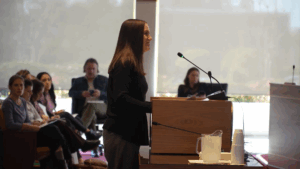
For decades, the North Carolina General Assembly has stalled on its constitutional duty to provide a sound, basic education for every student, as required by the Leandro ruling. On Feb. 18, after two years with no progress, the NC Justice Center joined Every Child NC coalition partners at the NCGA to urge NC lawmakers to fully fund public education.

Read the Every Child NC press release.

Read news coverage:

Parents, educators ask for NC Supreme Court ruling over multi-billion Leandro lawsuit plan

Leandro case: Activists in Raleigh push for answer, funding

By Payton Belvin and Laura Webb, with contributions from the NC Justice Center’s Education & Law team

View the PDF report.

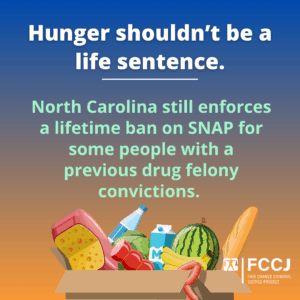
Across North Carolina, people do not qualify for food assistance because of a past drug conviction.

The consequences of denying access to SNAP (the Supplemental Nutrition Assistance Program) extend far beyond the re-entering individuals. When parents are denied access to food assistance, new research shows the effects are felt throughout their households— shaping children’s emotional wellbeing, academic success, and long-term stability.

In 2025, the North Carolina Justice Center partnered with Payton Belvin, a Master of Public Policy (MPP) student studying at the University of North Carolina at Chapel Hill (UNC), to conduct a preliminary qualitative study on the North Carolina Felony SNAP Ban’s impact on children and families.

The research emphasizes a powerful truth—the consequences of the SNAP ban extend far beyond individuals with a felony conviction. When parents are denied access to food assistance, the effects are felt through their households, especially for their children. It shapes children’s emotional life, academic performance, and long-term economic stability.

Living with a family member who is denied SNAP increases children’s vulnerability and chance of entering the “school-to-prison pipeline.”

An Inhumane Policy That Worsens Hunger and Poverty

SNAP is one of the most effective tools for reducing hunger and poverty, lifting hundreds of thousands of North Carolinians, especially children, above the poverty line. A 1996 federal law instituted a ban on SNAP benefits for people with felony drug convictions, a harmful policy rooted in the failed “War on Drugs.” While many states have since fully opted out of this punitive federal ban, North Carolina remains one of the few states that still enforces it.

In 1997, NC adopted a partial opt-out. Individuals with Class H or I felony drug convictions can regain access to SNAP benefits after six months, if they meet special requirements including drug treatment. Those with Class A through G felony drug convictions or out-of-state felony drug convictions—face a lifetime SNAP ban.

These overly punitive exclusions deny food assistance to individuals who already face significant economic barriers. A felony conviction often means an extremely elevated rate of food insecurity (91% of recently released people are food insecure) driven by unpredictable employment. Denying individuals, children, and families eligibility for SNAP food benefits only deepens incredible hardship for marginalized individuals and their families.

Research shows that denying people food assistance increases hunger, worsens health outcomes, and undermines successful reentry. Payton Belvin’s MPP research reinforces this evidence and highlights the profound and lasting harm that the felony SNAP ban inflicts on the educational outcomes, behavior, and long-term well being for children.
How the Felony SNAP Ban Harms Families

Working with non-profit organizations, Belvin recruited and interviewed 21 participants for MPP study. She collected responses from 14 individuals who were denied SNAP because of a felony drug conviction, five adults who were between the ages of 5 and 17 living with a parent who was impacted by the felony SNAP ban, and two policy advocates.

Therefore, the report’s findings draw primarily from impacted individuals who were excluded from SNAP or who were children in excluded households. Responses from policy advocates are incorporated to provide additional context to the themes identified by directly impacted participants.

Read the Full Report

Belvin’s study revealed the following themes:

1. Families experience chronic food insecurity.
More than 90% of directly impacted parents interviewed shared that they frequently run out of food. Every former child participant, who grew up with at least one disqualified parent, also reported that their family frequently runs out of food.

Parents describe feeling helpless as they struggle to feed their children. Despite meeting the SNAP program’s income eligibility, their felony drug conviction disqualifies them from from receiving assistance. 

2. Families rely on unsustainable alternatives to get by.

Without access to SNAP benefits, most families visited overburdened food banks, obtained food from friends or relatives, or skipped meals. Many interviewed parents often sacrificed their own meals so their children could eat. Participants described these alternatives as “unsustainable” and “unreliable,” emphasizing that these options cannot replace the stability and purchasing power of SNAP benefits.

3. The SNAP ban directly harms children’s academic and emotional wellbeing.

The research also identifies  the impact on children’s academic and emotional wellbeing. Parents denied SNAP and their children consistently report increased anxiety, stress, difficulty concentrating in school, social withdrawal, depressive symptoms, and trouble sleeping. Parents and former household members consistently report anxiety, stress, difficulty concentrating, social withdrawal, depressive symptoms, and trouble sleeping.

“My kids seem more anxious and stressed, especially when they’re hungry. My youngest has trouble sleeping because they’re worried about our situation.”

More than 70 percent of SNAP excluded parents said their children struggled academically during periods without SNAP, and every participant who grew up in an excluded household said food insecurity negatively affected their long-term educational and behavioral outcomes.

“I always get upset due to hunger… Since I couldn’t concentrate most [of the] time at school due to hunger, I [lost] passion for schooling.”

4. Food insecurity increases risks of entering the school-to-prison pipeline.

Among participants who were children during periods of SNAP exclusion, 80% reported they or their siblings faced disciplinary action during disqualification. Many also described feeling isolated or ashamed at school.

When hunger drives behavioral changes in the classroom, children are at greater risk of being pushed into the carceral system through the “school-to-prison pipeline.”

Take Action Now to Reduce Harm to Food-Insecure Families

The NC Justice Center calls on the NC General Assembly to opt out of the felony drug SNAP ban. No child should go hungry because of a parent’s past felony drug conviction. Ending the felony SNAP ban is an evidence-based policy change which would align North Carolina with the majority of states who decided to opt-out of the ban.

Opting out of the unfair and discriminatory federal SNAP ban would promote successful reentry, increase employment rates, lower poverty and food insecurity, reduce overdose rates, and ensure that children receive adequate nourishment.

Build awareness on social media

Help us change the narrative on food access.

Watch the SNAP Ban Documentary

If you can, host a documentary screening.

Support community food resources
Donate and volunteer with local food banks and organizations to help people navigating hunger.

Contact your state legislators

Request they support full repeal of North Carolina’s felony SNAP ban [action alert]

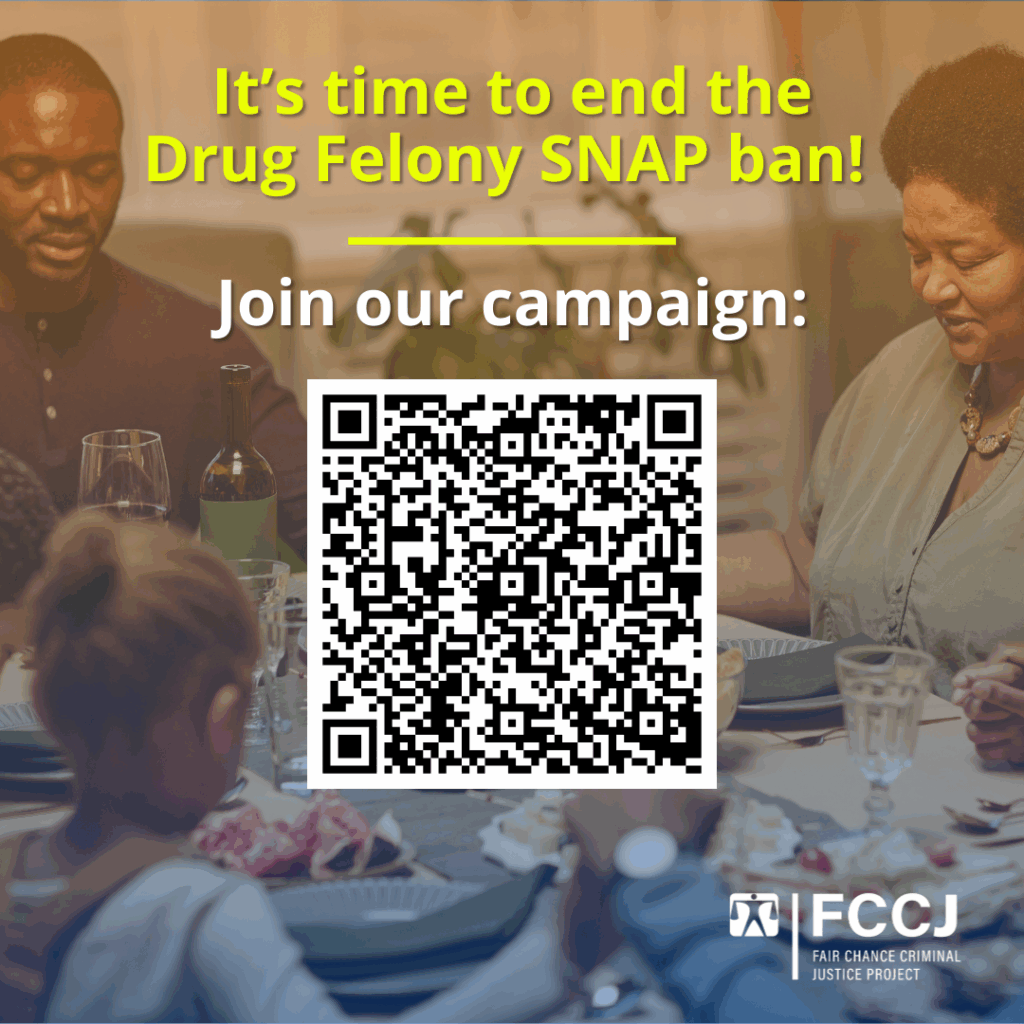
Join the statewide campaign

Get connected with the movement to improve food access for individuals and their families across North Carolina.

Opinion: A child of immigrants, no longer alone in fear

Growing up as the daughter of undocumented Latino immigrants, Andressia Ramirez knew fear and uncertainty. Now, she’s found hope in her hometown of Wilson, N.C.

“What’s giving you hope?”

It’s a question I had come to dread. It comes up constantly in advocacy spaces these days, including all around North Carolina. I always find an answer, but the truth is, I hadn’t really felt hopeful in a long time — until recently.

The last year has been emotionally shattering. Undocumented people have always lived with fear, rooted in lacking a piece of paper that dictates whether your life is considered valid or disposable. Now, federal agents are stopping people for how they look, not what they’ve done. We’re seeing U.S. citizens killed by federal immigration agents. People are starting to understand that no one is safe. Entire communities are canceling medical appointments. Parents are not taking their children to school. People are skipping work, not because they want to, but because survival requires caution. Fear has become a daily calculation.

I know this feeling intimately. And not just from this year.

My parents immigrated from Querétaro, Mexico, and settled in Wilson County, N.C, when I was 8 years old. I remember learning in elementary school that my mother was undocumented. From that moment on, it became our biggest secret. I couldn’t tell anyone because anyone knowing could be a threat. My brothers and I grew up understanding that our mother could be taken from us with no warning.

We learned how to listen carefully, how to stay quiet, how to carry fear without letting it show.

For most of my life, I held onto one hope: that one day my mom would become a citizen. In high school, I felt an overwhelming need be the absolute best student, so that one day I could petition for her. She obtained her green card the year I graduated from college in 2019 and became a citizen in 2025.

Read the full post on Beacon Media.

Andressia Ramirez in an engagement coordinator with our Workers’ Rights Project.

Last year, President Trump’s “One Big Beautiful Bill” Act created a new federal school voucher program to advance his agenda of dismantling public schools. The program, which is set to begin in 2027, will allow wealthy taxpayers to receive tax credits of up to $1,700 per year by donating to scholarship granting organizations (SGOs) that pass out school vouchers.  

To be eligible to receive a voucher, families must meet the program’s income requirements, which vary based on geography. In Raleigh, families earning up to $400,000 per year would be eligible to receive these vouchers for private school tuition and other vaguely-defined educational expenses 

Fortunately, states aren’t forced to participate in this program. States must opt into the program. Governors from Oregon, Wisconsin, and New Mexico have stated that their states will not participate. 

Unfortunately, Governor Stein has expressed an openness to participating. In vetoing the General Assembly’s efforts to force North Carolina into participating in this program, Stein emphasized his hope that the Trump administration might allow the program to be used to benefit public school students: “I see opportunities for the federal scholarship donation tax credit program to benefit North Carolina’s public school kids. Once the federal government issues sound guidance, I intend to opt North Carolina in so we can invest in the public school students most in need of after school programs, tutoring, and other resources.” 

“Sound guidance” allowing public school students to receive vouchers under this program is unlikely to arrive. The Trump administration has shown no interest in supporting public school students. But even if sound guidance does arrive, Stein should still opt North Carolina out of the program. 

There is a misconception that the funds flowing to SGOs would constitute “free money” that could be deployed to help students who need it the most. That argument ignores the many costs that accompany participation in the federal voucher scheme. 

First, the state would need to provide oversight of SGOs to minimize the fraud and abuse endemic to voucher programs. Currently, North Carolina spends $18.6 million to administer and oversee its two voucher programs. Even with this high level of administrative spending, there’s little financial oversight. There have been at least 43 instances where private schools received more vouchers than they had self-reported students, an indication that some private schools may be using “ghost students” to defraud taxpayers. Additionally, the state only verifies the incomes of four percent of applicants, leaving the door wide open for families to claim bigger vouchers than they are due. 

Without state oversight, the avenues for fraud under the federal voucher program could be blown wide open. Under the federal program, there would be a network of private, nonprofit SGOs accepting donations and distributing vouchers to North Carolina familiesInitial, draft program rules would require the state to approve all eligible SGOs, a low bar that would authorize almost any nonprofit that wants to participate. Participating SGOs are allowed to keep 10 percent of donated funds for “administrative costs,” making participation potentially lucrative. 

Presumably, the “sound guidance” that Governor Stein is seeking would include authority to make sure that these SGOs are in fact providing vouchers to actual students who meet program eligibility requirements, and that funds are used for actual educational expenses. We know from studies of existing voucher programs that, absent state oversight, SGOs could participate in self-dealing and the funding of ghost students, and parents could misspend the funds on purchases unrelated to education. 

Stein must also consider additional voucher-related costs: widening economic inequality, declining academic outcomes, and increasing school segregation.  

Our analysis shows the vast majority of federal voucher funding is awarded to disproportionately wealthy families who have already enrolled their children in private schools. In North Carolina’s largest voucher program, 85 percent of new funding has gone to such families, worsening the divides between wealthy and working-class North Carolinians. 

For families swapping their public school for a private one, the state will have to manage the costs of those children receiving a subpar education. Studies of voucher programs in Washington, DC IndianaLouisiana, and Ohio found that voucher students perform far worse academically than their peers who remain in traditional, inclusive local public schools. Many of these poorly served students return to the public school system where they then require additional resources to compensate for the inferior education they received in private school. 

Additionally, voucher programs divide students. At a time when our democracy and economy require a renewed dedication to learning how to successfully interact with people from diverse backgrounds, voucher programs entrench division. In North Carolina, 75 percent of voucher students are white, compared to 42 percent of public school students. Students attending less diverse schools are more likely to develop negative views of other racial groups and less likely to live in integrated neighborhoods as adults. 

The costs of a federal voucher program would undoubtedly expand in future years. One hallmark of voucher programs across the country is that they begin on a limited basis and then quickly expand once they gain a foothold. North Carolina’s main voucher program was introduced as a small, $11 million program tightly targeted towards families with low incomes looking to leave public schools. Now, it’s a $655 million program open to millionaires who have already enrolled their children in exclusive private schools. If the Trump administration has its way, the program will likely evolve in ways that are harmful for public school students. 

Alternatively, what happens in future years if the federal government revokes funding for the program? In that scenario, state leaders would face intense pressure to provide state funding so that no student loses their voucher. 

Stein must also consider the political costs of expanding voucher programs. The federal voucher program is the centerpiece of President Trump’s education agenda. Rejecting the program helps throw sand in the gears of an authoritarian and fascistic administration that is openly hostile to public education.  

Opting in, on the other hand, gives the current administration a win, while flying in the face of public opinion. According to a May 2023 poll from the Center for Racial Equity in Education, just 33 percent of North Carolinians support vouchers. Voters have rejected vouchers each of the 17 times states have put vouchers to a referendum, even in deeply red states like Nebraska and Kentucky. Voters correctly recognize that vouchers are just a tool to divide us and put more money into the pockets of the wealthy. 

By unambiguously rejecting the federal voucher program now, Stein can shift the education debate back to where it belongs: securing full funding for the constitutionally mandated Leandro Plan. The tutoring and after school programs that Stein wants would become readily affordable if schools finally receive the 40 percent state funding increase mandated by the Supreme Court. Under Leandro, such programs could be provided for all students, not just those whose parents apply for a voucher.  

(February 9, 2026—Raleigh, NC) 2026 marks 100 years of celebrating Black History. 100 years of uplifting the profound resilience, joy, and intelligence of Black people, and their unique contributions that have helped shape our country.   

Black history is American history, despite efforts to dilute or erase it. This month serves as a time to honor the past and those who fought for the rights and dignity of Black people, and to celebrate the collective strength, power, brilliance, and creativity Black communities hold today. 

Black History Month initially began as Negro History Week in 1926, organized by Dr. Carter G. Woodson, founding member of the Association for the Study of Negro Life and History, to celebrate and commemorate Black life and achievements. As it grew in popularity, the Association began pushing to extend the celebration to a month.  

In February 1975, President Gerald R. Ford became the first president to observe Black History Week, and the following year, became the first President to recognize Black History Month during the U.S. Biennial Celebration. In 1986, Congress passed a public Law designating February as National Black History Month.  

Knowing Black history also means seeing how systemic oppression continues today through federal, state, and local policies that harm the health, education, livelihoods, and freedom of Black individuals, families, and communities. Systemic oppression manifests today in many Black communities in numerous ways—from under-resourced schools, shameful maternal and infant mortality rates, and other inequitable health outcomes—to police violence, unjust treatment by judicial systems, discriminatory employment practices, and other barriers to social and economic mobility.

Despite this adversity, Black people have risen with joy and brilliance. During Black History month—and every month—the NC Justice Center celebrates, amplifies, and stands in solidarity with Black people who continue to advocate, lead, organize, create, build collective power, and drive change in their communities and throughout the world.  

At a time of intensifying threats to the safety and dignity of marginalized communities, the NC Justice Center is committed to dismantling pervasive inequities in housing, education, employment, and health care—and fighting for fairness, well-being, and opportunity for all.

Senior Energy Policy Advocate Claire Williamson recently published an op-ed on how harsh winters and Duke Energy rate hikes impact North Carolina families.

As winter drags on, families across North Carolina are feeling the cold. For many of the low-income households the North Carolina Justice Center serves, this season doesn’t just mean turning up the heat — it means agonizing choices between paying the power bill or putting food on the table, filling prescriptions or covering rent.

Duke Energy’s latest proposal to raise rates by 15% over two years threatens to make those choices even harder.

Read Claire’s full op-ed at NCNewsline: When the heat turns on, bills shouldn’t break families • NC Newsline


A recent NC Newsline report examines how Durham’s updated housing code is influencing tenant advocacy efforts across the state. The article includes insight from housing advocates and members of the NC Justice Center litigation team who have supported tenants’ advocacy efforts in Durham.

In North Carolina, landlords are generally required to make pairs to keep rental units safe and habitable. The Durham ordinance adds additional tenant protections by making it illegal for landlords to collect rents if they are not following the law.

“What the ordinance does is sort of restrict what the landlord who has been found in violation of the code can do, which is collect rent,” said Peter Gilbert, director of litigation at the N.C. Justice Center.

Read the full NC Newsline article here.

For additional context on the fight to win tenant protections in Durham, read the NC Justice Center’s feature on the student advocate who helped advance pro-tenant policy and elevate tenant voices in Durham.

(Raleigh, NC – January 30, 2026) North Carolina is the only state that entered the new year without a budget. More than 200 days have passed since lawmakers failed to meet the July 1, 2025, deadline to approve one for the 2025–2027 fiscal year.

The budget determines key funding for education, health care, and infrastructure, but lawmakers likely won’t be voting on any measures until April. As a result, teacher salaries are frozen, and school districts are unsure whether they will get necessary funding for classroom materials, instructional support, professional development, and adequate staffing.

Mary Jane Bowman, 2025 Person County Educator of the Year. courtesy: North Carolina Senate Democratic Caucus / ‘No Budget Hearing’ – November 19, 2025.

“We’re not respected and valued as we should be. The critical role that we play for students and our community’s well-being is not valued. Teachers do more with fewer resources. Without proper compensation, your morale just erodes,” said Mary Jane Bowman, 2025 Person County Teacher of the Year.

In November of last year, Bowman gathered with other educators and community advocates to express how this financial uncertainty has hampered student development, devastated learning environments, and negatively impacted the lives of teachers during a public hearing titled the “The Real-World Impact of Failing to Pass a State Budget” at the NC General Assembly. Organized by the North Carolina Senate Democratic Caucus, the hearing sought to convey the growing consequences of the budget impasse. Several NCJC staff members attended the hearing.

“Generations of North Carolina’s children have had their constitutional right to educational opportunities violated for the past 40 years. The landmark Leandro case, originally filed with state courts from all ideological backgrounds, consistently finds that this violation is ongoing,” said Matt Ellinwood, Director of the Education & Law Project.

“The state has never developed a plan to remedy this violation, but one has been developed in the Leandro case, which the Legislature refuses to fund and implement. Now, the lack of a state budget leaves us even further today from funding and implementing a sound, basic education for all students than we were 40 years ago,” Ellinwood continued.

Educators have long shouldered the burden of reaching into their own pockets to provide basic supplies for their students. While the funds needed to supply classrooms continue to increase, teacher pay has stagnated. A recent report by the North Carolina Association of Educators reveals that teachers across the state are now spending more than $1,600 of their personal money on supplies. 

“More than half of the professionals working with children every single day are working under the same pay they had before, despite growing responsibilities and ever-increasing expectations,” Bowman said.

“This year, health care costs have increased dramatically for educators and staff across our district,” she continued. Bowman said this has forced many educators, including herself, to find cheaper health plans.

“For teachers with six or more years of experience, premiums have doubled. And in many cases, they are paying more for less coverage. These are educators who have committed years of their lives to serving students. Yet they are being asked to shoulder an unfair financial burden just to maintain essential healthcare,” Bowman said.

She reported she had to drop from the 80/20 plan to the 70/30 plan after costs doubled.

Bus drivers, instructional assistants, cafeteria workers, custodians, and office staff have also experienced loss of wages“For these employees, take-home pay has decreased anywhere from $120 to $312 a year. These are also individuals who did not receive a raise and already work for modest wages and losing this amount has an impact on their ability to meet basic needs,” she explained.

Bowman said underpaying teachers and support staff sends a painful message—that public education is not a priority for the state.

As a result of being undervalued and unsupported, it makes it harder for schools to recruit and retain qualified teachers, which hurts student outcomes, school culture, and the overall quality of education.

“The high turnover rate and a lack of stability affect classrooms,” Bowman said. “It’s uncertainty for the students. It’s uncertainty about, ‘who am I going to see in my building?’ Consistency is required for building relationships with [the children we serve],” she explained.

“Our teachers deserve stability. They deserve competitive pay. And they deserve a budget that reflects the importance of the work they do every single day,” Bowman said.

This story highlights just some of the challenges school districts across the state are facing. The NC Justice Center calls for the North Carolina General Assembly to pass a budget that prioritizes health care and provides full funding for public education as mandated under the Leandro Plan.

Read our previous article to learn how the lack of a state budget is impacting healthcare.

(Raleigh, NC – January 28, 2026) The North Carolina Justice Center joined over 1,000 nationwide civil and human rights organizations in signing on to a Detention Watch Network-led coalition letter Jan. 27 that urges Congress to halt all funding to Immigration and Customs Enforcement (ICE) and U.S. Customs & Border Protection after the recent shooting deaths committed by federal agents in Minneapolis and the escalating violence inflicted on communities across the country.

The text of the coalition letter is below and found online here with the list of signers.

Dear Members of Congress,
We the undersigned 1,025 organizations write to express our horror, outrage and deep grief about the news that federal agents have executed a human being in broad daylight on the streets of Minneapolis.

How many more people have to die, how many more lies have to be told, and how many more children must be used as bait and abducted, before Congress fulfills its responsibilities and stops these out-of-control agencies from continuing to violently attack our immigrant communities and communities of color, as well as their many allies and supporters?

We demand an immediate halt in all funding for these deadly operations until the violence, abuses, and deaths in American communities and in immigration detention centers stop. Congress must refuse to provide one dollar to Immigrations and Customs Enforcement (ICE) or Customs and Border Protection (CBP) Border Patrol through the appropriations process and immediately take action to revoke the tens of billions already given through last summer’s reconciliation bill.

We demand that you act decisively and show DHS and the communities you serve that this cruelty and lawlessness is unacceptable and must end now. When federal agents are patrolling the streets of American cities and gunning people down in broad daylight, the bare minimum response is to stop the funding that enables these violent agencies to carry out these atrocities. You have the power and responsibility to stop this. What you do now will be remembered for future generations – take a stand today while you still have the power to do so.

Click here to read the Detention Watch Network-led letter and view the more than 1,000 organizations that signed on.

(Durham, NC – January 26, 2026) Tenants in Durham now have new protections, thanks to the lobbying work of 17-year-old Milo Graber and Riverside High School’s Affordable Housing Club. Durham City Council unanimously approved an amendment to the city’s housing code in October 2025. The new ordinance, modeled after a similar law in Charlotte, makes it illegal for landlords to collect rent from apartments or homes with unsafe or dangerous living conditions.

This includes having unsafe wiring, unsafe ceiling or roofing, unsafe drinking water, severe pest infestations, heating equipment that doesn’t work in the winter months, and non-functioning toilets. If landlords do not fix these issues within 72 hours, they can be found in violation of the new ordinance.

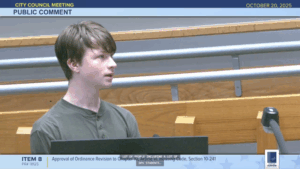
Milo Graber speaking at Oct. 2025 Durham City Council work session.

Graber and supporters of the ordinance say it’s a powerful tool that tenants can use to enforce the basic standards of habitability in their homes, and even the playing field if eviction proceedings are initiated. “They can bring this to the negotiation table,” Graber said, and use it to defend themselves against landlords demanding rent for unsafe or unstable units.

“It will make landlords more likely to maintain their properties in safe and livable condition because of the risk of losing rent payments if they don’t,” Graber wrote in his Op-Ed for INDY Weekly.

Safe, affordable housing has long-dominated conversations amongst Durham’s leaders and community members. “Everyone agrees we have an affordable housing crisis. But it’s difficult for us to do anything because we’re arguing about how we should address this,” he said. During his sophomore year, Graber conducted a research project on housing policy in relation to slumlords. He interviewed Peter Gilbert, Litigation Director for the NC Justice Center, who talked with him about a housing ordinance Charlotte passed in 2007 that protected tenant rights.

“Due to the high demand for affordable housing and limited supply of subsidized units, tenants are often left with no choice but to accept substandard housing and landlords have little incentive to make necessary repairs. This ordinance should improve the bargaining position of tenants seeking safe and affordable housing,” Gilbert said.

This inspired Milo to get a similar law passed in his community.

“I felt like [the ordinance] was a commonsense thing that should be on record. Landlords are focusing more on how much money they can bring in rather than giving people a safe place to live,” Graber said.

Graber has lived in Durham for most of his life and has seen how unstable housing conditions interfere with the lives of his peers and classmates. “Struggling to pay rent makes it very hard for people to stay in one home for a long period of time,” he said.

“A lot of DPS students live in unsafe and unhealthy conditions and live in fear of being evicted because they are being charged such high levels of rent for these units. [In some cases,] students face being evicted. That can be very disruptive, especially if they’re forced to move school districts because they had to find housing in a different area,” Graber said.

“If you’re joining as a sophomore, junior, or even a senior, it’s so much harder to get to know people because they already have an established friend group and may not be willing to branch out,” Graber explained. He also witnessed how this affects a student’s ability to focus on school and complete assignments.

After finding other students who wanted to advocate for those affected by unsafe and unreliable housing, Graber co-founded Riverside High School’s Affordable Housing Club. Soon after, the group began to mobilize. The students attended eviction court proceedings and started interviewing attorneys. In January 2025, the group wrote a report on the ordinance in Charlotte, detailing its impacts and its authorization under North Carolina law, and explained why it should be implemented in Durham.

They sent the report to community organizations in the spring, including the Triangle Tenant Union and Durham’s People Alliance, the latter of which connected them to councilwoman Chelsea Cook, who represents Durham’s west end neighborhoods.

“When we met with her, she thought it was a really great idea, and wanted to support it,” Graber said. Once they crafted a proposal, Councilwoman Cook added it to the agenda for the next work session.

All seven city council members voted to adopt the measure. “I was surprised that it passed unanimously because it felt like the councilmembers were on the fence about it during the work session,” Graber said.

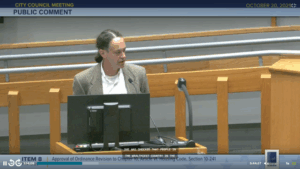
Peter Gilbert speaking at Oct. 2025 Durham City Council work session.

Gilbert spoke in favor of the ordinance at the October City Council meeting. “The sustained advocacy of the students, community groups, and organized tenants, including the NC Tenants Union, was pivotal in passing the ordinance,” Gilbert said. Former NC Justice Center attorney Jack Holtzman also spoke in favor of it at a prior meeting.

Durham is the now the fourth municipality in North Carolina to adopt an ordinance banning landlords from collecting rent if units are deemed unsafe. “My favorite part of this process was meeting with community organizations and talking to people who wanted to help, and asked, ‘what can we do?’, “he said.

Graber is graduating from Riverside High School later this year and plans to attend college in the fall. He hopes the Affordable Housing Club that he and his peers started will continue its work to defend and support Durham residents.