 One time Donation
 Events
 Recurring Gift
 Employer Gift Matching
 Stocks & DAF
 Endowment
 Justice Circle
 By Payton Belvin and Laura Webb, with contributions from the NC Justice Center’s Education & Law team
Across North Carolina, people do not qualify for food assistance because of a past drug conviction.
The consequences of denying access to SNAP (the Supplemental Nutrition Assistance Program) extend far beyond the re-entering individuals. When parents are denied access to food assistance, new research shows the effects are felt throughout their households— shaping children’s emotional wellbeing, academic success, and long-term stability.
In 2025, the North Carolina Justice Center partnered with Payton Belvin, a Master of Public Policy (MPP) student studying at the University of North Carolina at Chapel Hill (UNC), to conduct a preliminary qualitative study on the North Carolina Felony SNAP Ban’s impact on children and families.
The research emphasizes a powerful truth—the consequences of the SNAP ban extend far beyond individuals with a felony conviction. When parents are denied access to food assistance, the effects are felt through their households, especially for their children. It shapes children’s emotional life, academic performance, and long-term economic stability.
Living with a family member who is denied SNAP increases children’s vulnerability and chance of entering the “school-to-prison pipeline.”
An Inhumane Policy That Worsens Hunger and Poverty
SNAP is one of the most effective tools for reducing hunger and poverty, lifting hundreds of thousands of North Carolinians, especially children, above the poverty line. A 1996 federal law instituted a ban on SNAP benefits for people with felony drug convictions, a harmful policy rooted in the failed “War on Drugs.” While many states have since fully opted out of this punitive federal ban, North Carolina remains one of the few states that still enforces it.
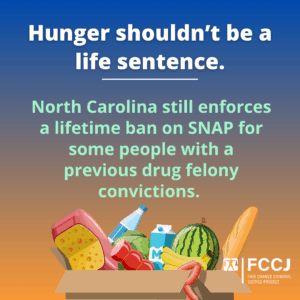
In 1997, NC adopted a partial opt-out. Individuals with Class H or I felony drug convictions can regain access to SNAP benefits after six months, if they meet special requirements including drug treatment. Those with Class A through G felony drug convictions or out-of-state felony drug convictions—face a lifetime SNAP ban.
These overly punitive exclusions deny food assistance to individuals who already face significant economic barriers. A felony conviction often means an extremely elevated rate of food insecurity (91% of recently released people are food insecure) driven by unpredictable employment. Denying individuals, children, and families eligibility for SNAP food benefits only deepens incredible hardship for marginalized individuals and their families.
Research shows that denying people food assistance increases hunger, worsens health outcomes, and undermines successful reentry. Payton Belvin’s MPP research reinforces this evidence and highlights the profound and lasting harm that the felony SNAP ban inflicts on the educational outcomes, behavior, and long-term well being for children.
How the Felony SNAP Ban Harms Families
Working with non-profit organizations, Belvin recruited and interviewed 21 participants for MPP study. She collected responses from 14 individuals who were denied SNAP because of a felony drug conviction, five adults who were between the ages of 5 and 17 living with a parent who was impacted by the felony SNAP ban, and two policy advocates.
Therefore, the report’s findings draw primarily from impacted individuals who were excluded from SNAP or who were children in excluded households. Responses from policy advocates are incorporated to provide additional context to the themes identified by directly impacted participants.
Read the Full Report
Belvin’s study revealed the following themes:
1. Families experience chronic food insecurity.
More than 90% of directly impacted parents interviewed shared that they frequently run out of food. Every former child participant, who grew up with at least one disqualified parent, also reported that their family frequently runs out of food.
Parents describe feeling helpless as they struggle to feed their children. Despite meeting the SNAP program’s income eligibility, their felony drug conviction disqualifies them from from receiving assistance.
2. Families rely on unsustainable alternatives to get by.
Without access to SNAP benefits, most families visited overburdened food banks, obtained food from friends or relatives, or skipped meals. Many interviewed parents often sacrificed their own meals so their children could eat. Participants described these alternatives as “unsustainable” and “unreliable,” emphasizing that these options cannot replace the stability and purchasing power of SNAP benefits.
3. The SNAP ban directly harms children’s academic and emotional wellbeing.
The research also identifies the impact on children’s academic and emotional wellbeing. Parents denied SNAP and their children consistently report increased anxiety, stress, difficulty concentrating in school, social withdrawal, depressive symptoms, and trouble sleeping. Parents and former household members consistently report anxiety, stress, difficulty concentrating, social withdrawal, depressive symptoms, and trouble sleeping.
“My kids seem more anxious and stressed, especially when they’re hungry. My youngest has trouble sleeping because they’re worried about our situation.”
More than 70 percent of SNAP excluded parents said their children struggled academically during periods without SNAP, and every participant who grew up in an excluded household said food insecurity negatively affected their long-term educational and behavioral outcomes.
“I always get upset due to hunger… Since I couldn’t concentrate most [of the] time at school due to hunger, I [lost] passion for schooling.”
4. Food insecurity increases risks of entering the school-to-prison pipeline.
Among participants who were children during periods of SNAP exclusion, 80% reported they or their siblings faced disciplinary action during disqualification. Many also described feeling isolated or ashamed at school.
When hunger drives behavioral changes in the classroom, children are at greater risk of being pushed into the carceral system through the “school-to-prison pipeline.”
Take Action Now to Reduce Harm to Food-Insecure Families
The NC Justice Center calls on the NC General Assembly to opt out of the felony drug SNAP ban. No child should go hungry because of a parent’s past felony drug conviction. Ending the felony SNAP ban is an evidence-based policy change which would align North Carolina with the majority of states who decided to opt-out of the ban.
Opting out of the unfair and discriminatory federal SNAP ban would promote successful reentry, increase employment rates, lower poverty and food insecurity, reduce overdose rates, and ensure that children receive adequate nourishment.
Build awareness on social media
Help us change the narrative on food access.
Watch the SNAP Ban Documentary
If you can, host a documentary screening.
Support community food resources
Donate and volunteer with local food banks and organizations to help people navigating hunger.
Contact your state legislators
Request they support full repeal of North Carolina’s felony SNAP ban [action alert]
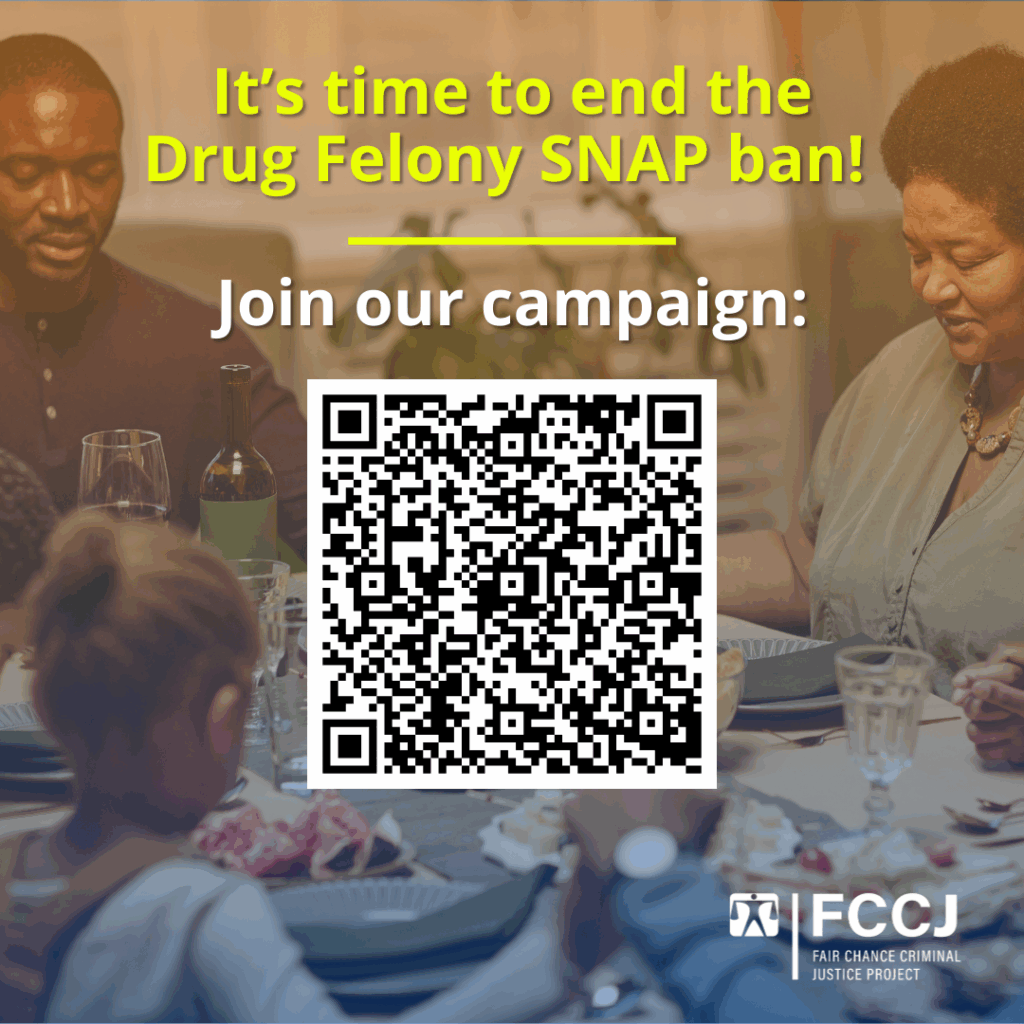
Join the statewide campaign
Get connected with the movement to improve food access for individuals and their families across North Carolina.